


Ikigai comes from Japanese culture, specifically from everyday life in Japan rather than from a single philosophy or religion. The word combines iki (life) and gai (value or worth), and it originally referred to the small things that make life feel meaningful, not just careers. It became associated with longevity and well-being through studies of Japanese communities, especially in Okinawa, where people emphasized purpose, contribution, and social connection as reasons to get up each day.
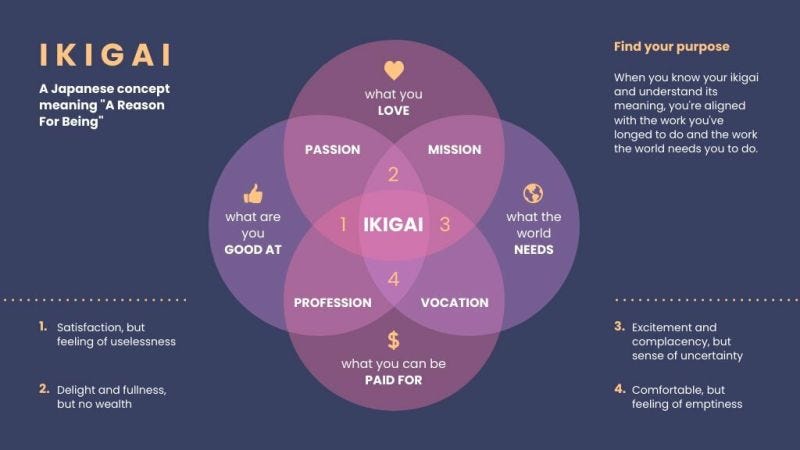
In today’s fractured culture, many of us struggle to find meaning and purpose. As a young man, I had no idea what my ikigai was. I wanted to be a lot of things, but I was focused on the bottom circle - what I can get paid for. It led me to a number of careers I thought would be lucrative, but none really offered me an opportunity to move the circles together.
I met my wife in my last year of law school and we moved to Portland. I had no community, but we built one together with our kids and that community is still strong. My family and that community provided me the meaning I wasn’t getting from my jobs. During my time in Portland, I had 5 careers, none of which stuck. I took satisfaction in helping others through my work as a financial planner, a mortgage banker, and wealth management advisor, but it wasn’t what I was meant to do. It was mostly just a way to provide for my family.
Today, I have an amazing job that collapses the circles. It’s hard, demanding, and I work a LOT. But I get to build things the world needs and my contribution to the team’s efforts are things that I (mostly) love. And, I think the things I get to do I’m pretty good at. I’m a lucky guy, but I spent over 20 years with highly separated circles.
There’s a couple of old saws I want to put to bed. First, the notion that work has to suck, otherwise they wouldn’t call it work. There can be truth to that, but there doesn’t have to be. We choose to enjoy whatever we’re doing, or we choose to be miserable. On my best days, even doing the dishes can be a quiet satisfaction. I don’t have a lot of those days, but when I remember to choose it, to take satisfaction in the routine maintenance of the home, I can find meaning and purpose in the mundane.

I don’t take joy in it - I’m not that enlightened - but I don’t grumble. And it’s in those moments I try to lock in that feeling so I can do it again when mowing, vacuuming, of folding we somehow infinite amount of laundry we seem to generate.
The second is “Just take what you love and make it your job!” This is a really dangerous take. The risk there (inevitability?) is that you destroy the love you have for the ‘thing.’ For example, I love scuba diving and spearfishing. It’s magical for me. but, to make that a job - either as a commercial fisherman or a charter captain relying on that to make my living, would inevitably make me never want to dive again. I think that resonates with most people. They intuit that it’s not likely to be a good outcome.
“Our ikigai is hidden deep inside each of us, and finding it requires a patient search.” - Japanese saying
However, if you study the circles, and think about who we are, what tasks we enjoy, and what we’re good at, you can then identify potential careers that can fulfill and sustain you. Unfortunately, we have created a culture that rewards grifters and takers. I think that’s the undefinable angst that Gen Z seems to have landed on - they aren’t satisfied with that worldview. And I am with them.
I would love to see a world that values humans for the value they contribute back to their community and society. That would honor the notion of ikigai and make the world - and each of us in it - better.